Work and projects by Shayan Poigai
Experience
- Sept 2025 — June 2026
CS Teaching Assistant & Algorithms Grader
Santa Clara University
- Mentored 40+ students in C++ — memory management, pointers, and OOP — and debugged logic errors live using GDB.
- Graded Theory of Algorithms for 40+ students across 2 sections, evaluating runtime analysis, greedy, divide-and-conquer, and dynamic-programming solutions.
- Dec 2025 — June 2026
Machine Learning Research Assistant
Santa Clara University
- Spent six months studying what people actually think about LLMs as a therapeutic tool, not what they say in surveys, but what they say to each other, unprompted, across mental-health communities on Twitter, Reddit, and YouTube.
- The modeling wasn't the hard part. 5,000+ scraped posts are a mess of slang, typos, and sarcasm; most of my time went into Pandas preprocessing, normalizing text until BERTopic, LDA, and NMF could surface real structure instead of noise.
- Co-authored the paper as primary writer, which meant learning LaTeX in Overleaf, fighting table formatting until the columns behaved, and hunting down references — figuring out which prior work actually supported a claim rather than just sounding adjacent to it.
- Writing the paper forced a rigor the code never did. Producing a topic model is one thing; defending why the topics mean anything is another.
- Co-authored a short paper accepted to HIBIBI 2026 (collocated with IEEE/ACM ASONAM), to be published by Springer - the payoff for months of wrangling messy data and learning to write like a researcher.
- May 2026 — Present
Founding Software Engineer
Adorus (adorusjewels.com)
- Adorus started as an idea between siblings. My sister and I co-founded it, split the work by what we're each good at, and agreed on one thing: build something we'd actually be proud to put our name on.
- Given my technical background, I took ownership of the entire engineering side. Every layer, data models, API contracts, component architecture, and deployment, is mine to design and be accountable for, which means there's no senior engineer to check my thinking. I've learned to be my own code reviewer.
- We seriously considered Shopify. Building it ourselves was cheaper and gave us full control over how the site works, so we went that way, a decision I own the consequences of every time something breaks at 2am.
- The stack: React.js/Node.js frontend, Java Spring Boot services, PostgreSQL, deployed on AWS EC2 with S3 and CloudFront serving product images through a private bucket. Most of the real work has been the unglamorous foundations: authentication, image pipelines, a schema that won't buckle when real orders arrive.
- The parts I couldn't build, we went and found. My sister and I reached out cold on social media to photographers and marketers working in the industry, asking people with real careers to help us. Learning to ask for help turned out to be a skill in itself.
- Next: building toward AI agents over an MCP server to give us a clearer read on customer behavior and satisfaction, so the site can adapt to how people actually use it rather than how we assumed they would.
- June 2026 — August 2026
Software Engineering Intern
HerbsPro
- 10 week Summer internship program where I developed backend features for the HerbsPro E-commerce web application
- Built backend infrastructure: a Python Model Context Protocol (FastMCP) server bridging a MySQL warehouse management system with LLMs, enabling agents to query live stock and write split-shipment pick tickets - automating order routing and cutting manual Warehouse Management System work by 30%
- Engineered a cache-aside Redis layer with event-driven invalidation for a 50,000+ SKU catalog, cutting MySQL query volume by 60% and product API response times from 200ms to 90ms.
- August 2026 - Present
Forward Deployed Engineer Intern
Countera
- Built and operated an AI data enrichment pipeline that processed 2,409 records across 372 sources, resolving the correct source page for 95.7%.
- Deployed vision-language extraction that read 1,084 structured documents directly from photographs - 45% of all records processed - covering data published only as images.
- Sept 2026 — Present
Graph Neural Networks & NLP Research Assistant
Santa Clara University
- Built a GATv2 graph neural network in PyTorch Geometric that spots when someone is becoming emotionally dependent on an AI assistant, reaching 96% accuracy on a held-back test set — about 4 points above the versions without the graph, with every margin holding up under resampling rather than resting on one lucky split.
- Moved the team onto Mental-RoBERTa, a language model trained on mental-health writing, which took accuracy from 91% to 96% and cut the missed cases roughly in half. The model can flag a conversation halfway through at 92%, and I tuned its confidence scores so they line up with how often it's actually right.
- Most of the work was trying to prove the result wrong before anyone else could. 26% of our 2,000 matched conversations shared word-for-word identical replies, which would have leaked test answers into training, so I redesigned the split. Training on one AI writer and testing on another dropped accuracy 18 points — the model was partly learning who wrote the text rather than the behaviour.
- Scrambling the labels and retraining scored exactly chance, which is what an honest setup has to do. Running the model six ways from three starting points separated what the graph actually adds (~1.4 points) from run-to-run variation, and an audit of the published research code we built on turned up five flaws in its method, including a step that let the model peek at the test set.
- Engineering: 4,000 conversations into graphs linking every message to the ones around it — 400,000 labelled links — in under a second with nothing failing the data checks, plus a FastAPI service returning a risk score and the three messages behind it in ~70ms, matching the offline pipeline to within a rounding error. Wrote the technical documentation, including 14 recorded risks to the method and a plain-language glossary.
Projects
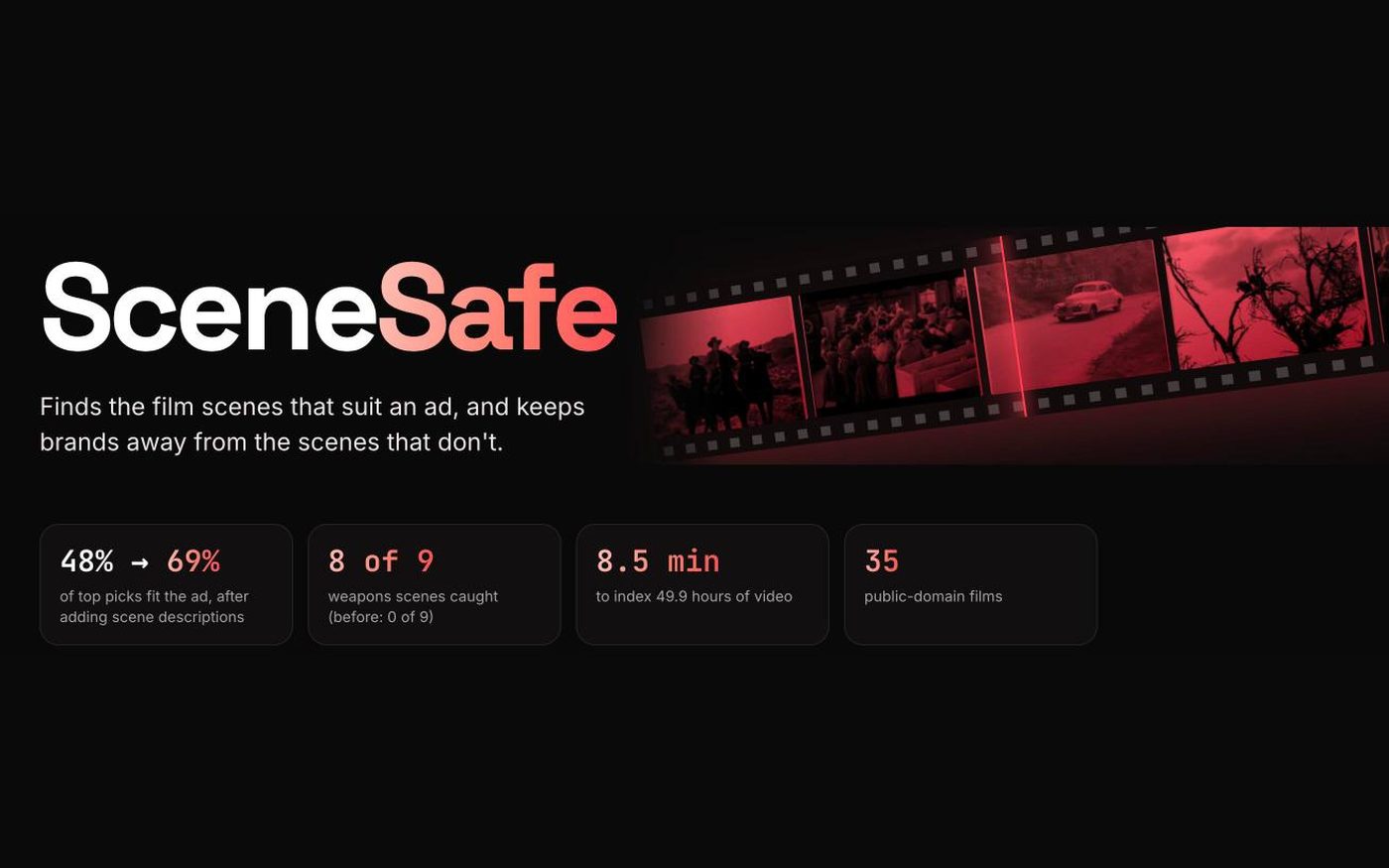
SceneSafe
September - October 2026- Places an ad in the film scene that suits it and blocks the scenes an advertiser can't be seen next to, across 35 public-domain films — 49.9 hours of video.
- Layering Qwen3-VL scene descriptions on top of OpenAI CLIP image search lifted how often an ad lands somewhere it fits from 48% to 69% of its top ten, and held on 7 films held back from development; weapons detection went from 0 of 9 test scenes to 8 of 9, cutting wrongly blocked scenes by 26 points while letting through 0.3 more risky ones.
Searching the library costs ~40× less than checking every frame — 403 → 10 seconds of compute per hour of video, with 179,545 frames in FAISS answering in 0.25 ms. Pricing the pipeline at ~$227 per 1,000 hours showed where the money actually goes: the models are 93% of it, the frame search 1.5%.
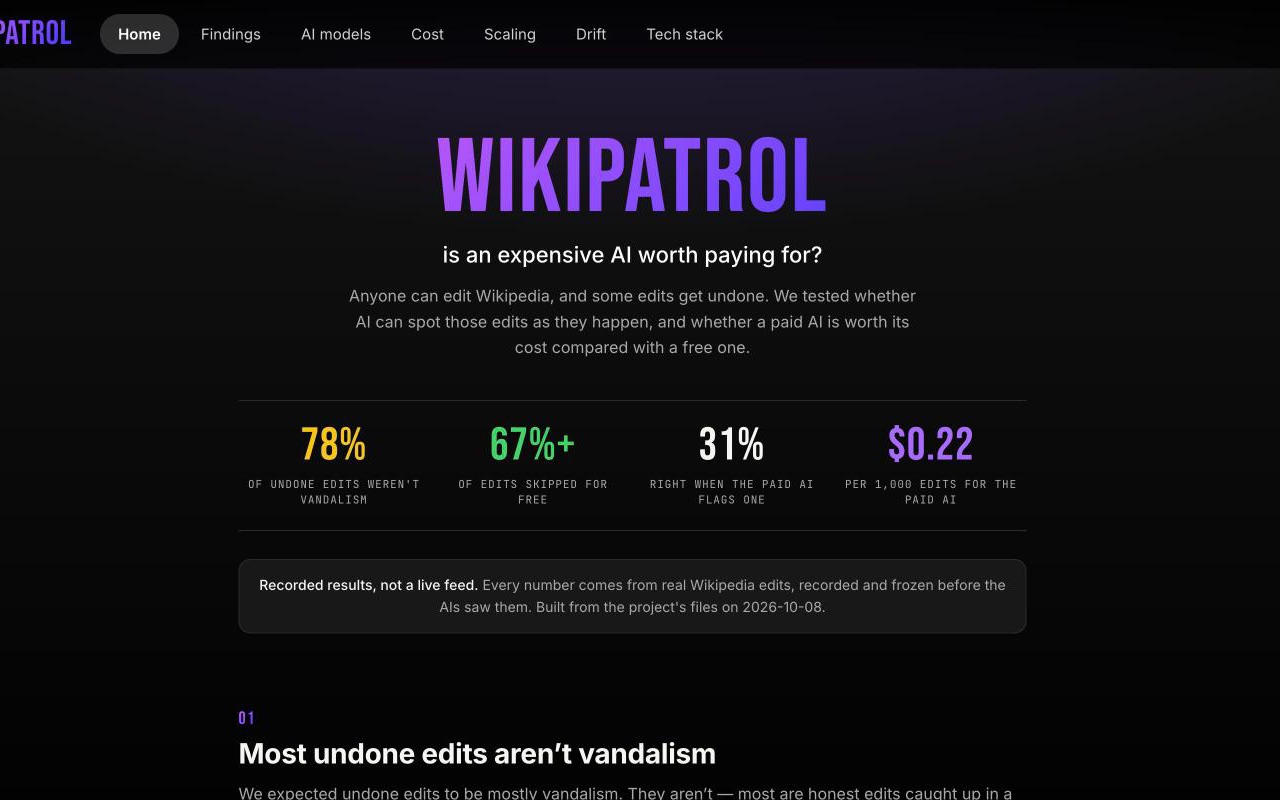
WikiPatrol
October 2026- A TypeScript + Kafka pipeline that reads every English Wikipedia edit the second it happens, and rides out a connection drop every 2–17 minutes without losing an edit or counting one twice.
- Tested whether a paid model earns its price: 31% of the edits it flagged really had been reverted, against 21% for a free model on a laptop, at ~$0.22 per 1,000 edits — while a free pre-filter cuts the edits sent to the AI by 67–87% and misses 13–24% of the bad ones.
About 78% of the edits Wikipedia reverts aren't vandalism, so judging intent was the wrong target — the project now predicts reverts instead.
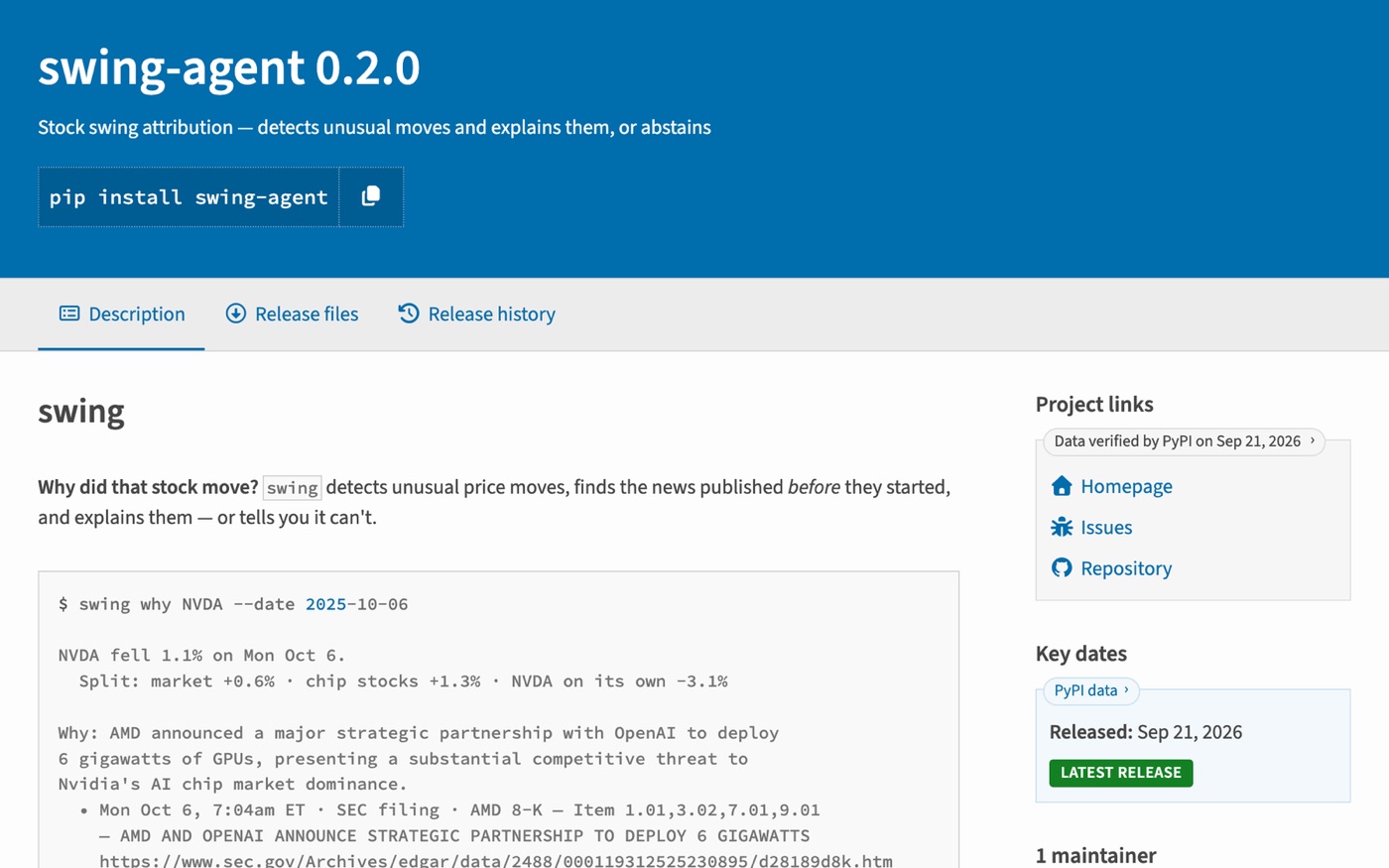
Swing Stock Analysis Agent
July - September 2026- Open-source CLI agent that detects unusual stock moves, retrieves news published before each move began, and explains the cause — or says "unexplained" rather than guessing.
- Splits each day's return into market, sector, and company-only moves, then pins the minute the move began from intraday bars — no model is involved until the final judgement, so "before" actually means before.
- Ingests 28 sources (SEC EDGAR, GDELT via BigQuery, RSS/IR feeds) into PostgreSQL + pgvector, deduplicated with MinHash and embeddings; one combined BigQuery query cut projected scan volume ~99%.
- A LangGraph pipeline strips any citation that doesn't resolve to a real retrieved article, and a verdict resting on a dropped citation falls back to "unexplained". 412 tests; published via PyPI Trusted Publishing.
The model never gets to invent a story: a placebo test that fed it deliberately unrelated evidence found 0 fabricated explanations in 38 trials — a number re-measured on every release rather than asserted.
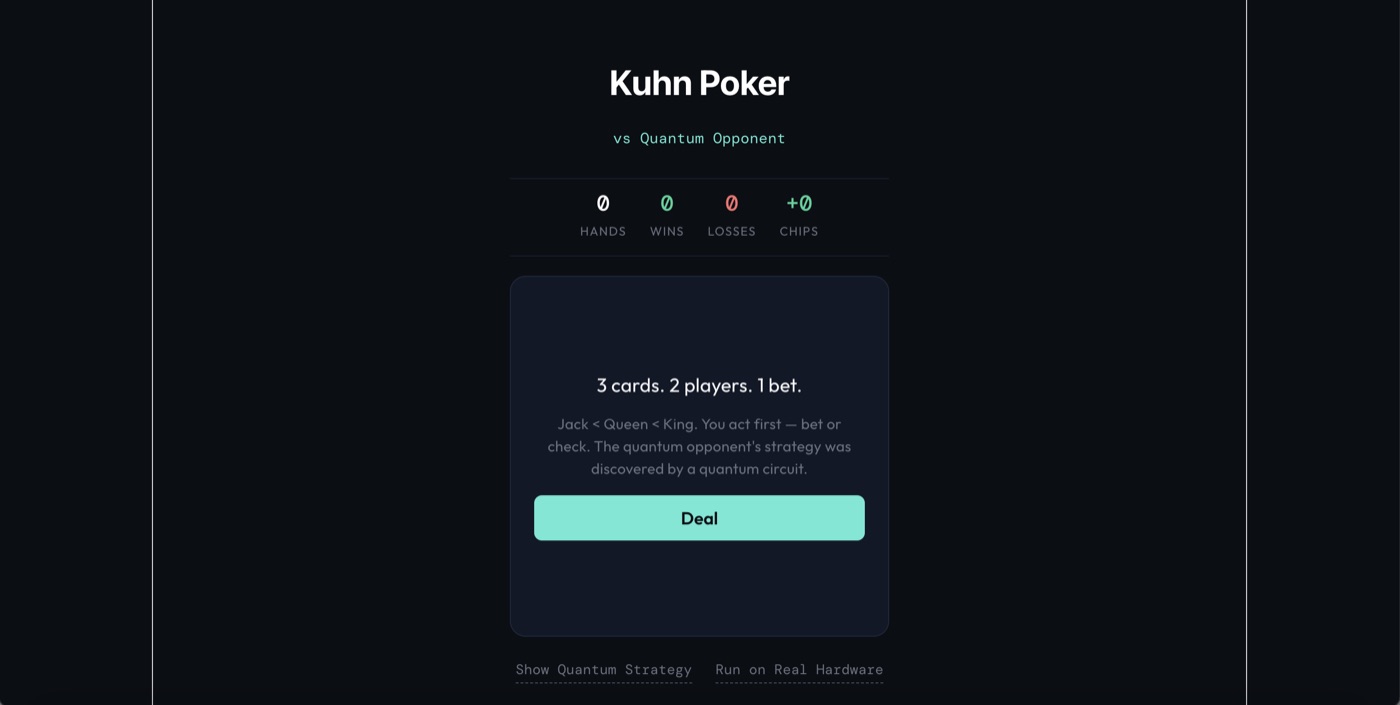
Kuhn Poker vs Quantum
June 2026- A 6-qubit, 12-parameter variational circuit (superposition + entanglement) infers your mixed strategy as you play.
- Full-stack: FastAPI backend + React frontend, deployed on Render and Vercel.
- Measurement-error mitigation keeps noisy qubit readouts from skewing the AI's decisions.
Ran on real IBM quantum hardware (ibm_fez): on a 4,096-shot run, the real-chip probabilities matched the ideal simulation within ~1.7 percentage points on average — the remaining gap attributable to quantum noise.
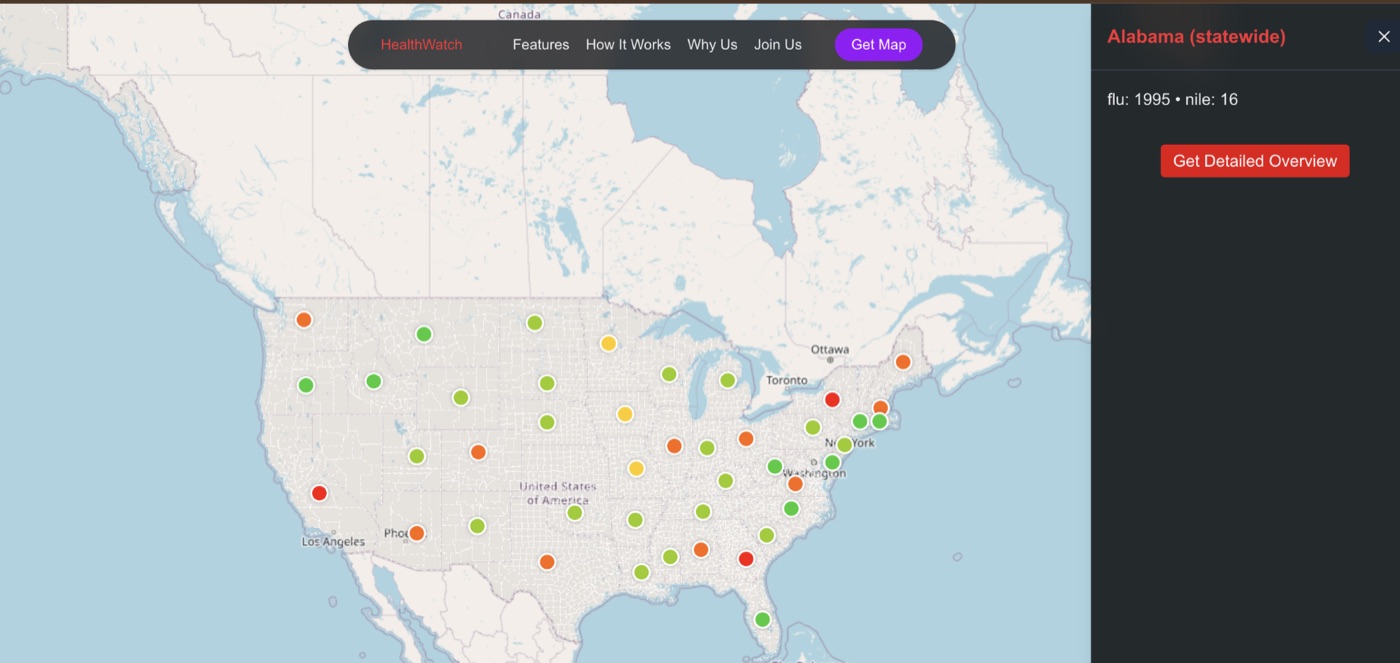
Disease Tracker
October 2025- FastAPI REST API serving real-time disease metrics and risk assessments with low-latency responses.
- AWS Bedrock drives an automated AI risk-scoring pipeline over public-health data.
- DynamoDB schemas designed for scalable ingestion and clean backend-to-frontend flow.
Built in a weekend at the AWS × INRIX 2025 hackathon — the Bedrock scoring layer is what turned a raw data feed into something that actually flags emerging hotspots.